
Stop Waiting for Magic Wands: Taking Ownership of Your Professional Growth Strategy
Estimated Read Time: 6 Minutes
G’day! Ever felt like your career or latest tech project has hit a bit of a brick wall? We’ve all been there—staring at a complex setup or a daunting career leap, wondering how to get to the next level without wasting months going down YouTube rabbit holes.
That’s usually when the lightbulb goes off: “I need a mentor.”
Watch the related video on YouTube.
Finding someone who has already walked the path you’re on is one of the fastest ways to level up.
But here’s the kicker: Simply landing a mentor won’t magically transform your skill set overnight. A mentor isn’t a wizard with a magic wand; they’re your torchbearer. To actually get results, you need to understand how the mentorship cycle works, what your mentor’s actual role is, and—most importantly—why you hold the steering wheel.
Let’s break down the end-to-end framework to help you find the right guide, build a high-impact relationship, and guarantee real progress.
What Does a Mentor Actually Do? (Hint: They Don’t Babysit)
When you team up with a mentor—whether it’s a paid arrangement, an industry contact, or an informal peer setup—it’s crucial to set expectations early. A mentor’s primary job isn’t to sit next to you and hold your hand through basic tutorials; in today’s digital world, online courses, documentation, and training platforms handle the heavy lifting for raw skills.
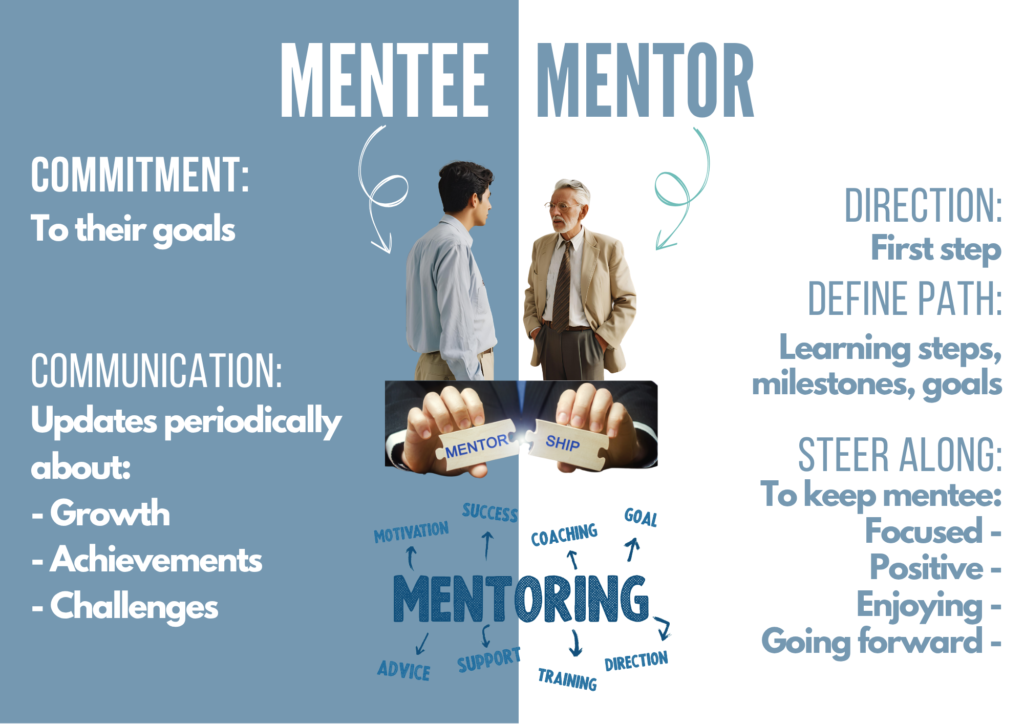
Instead, a mentor serves as your high-level navigator. Their core responsibilities include:
- Setting Direction & Long-Term Goals: Helping you filter through the noise to define clear, realistic outcomes.
- Building Roadmaps: Mapping out sequential action steps based on your specific baseline skills.
- Course Correcting: Pivoting your strategy when you hit unexpected personal or technical roadblocks.
- Providing Motivation & Accountability: Keeping you focused on the bigger picture when the going gets tough.
A mentor’s greatest reward is watching you succeed—they are the torchbearer showing you the path, but you still have to walk it.
The Golden Rule of Mentorship: Owning the Communication
If there is one absolute dealbreaker in any mentorship, it’s communication ownership.
Too many mentees make the mistake of waiting for their mentor to follow up with them. Your mentor is not your babysitter. It is never their job to chase you for updates, remind you of deadlines, or ask why you missed a milestone.
The Golden Rule
As the mentee, 100% of the communication cadence is your responsibility.
When you fall silent or lapse in communication, the entire framework breaks down. Even if life gets chaotic—you get sick, family commitments crop up, or work gets crazy—your job is to check in and communicate the delay.
What You Should Standardise in Your Updates
To keep your mentor engaged, structure your periodic updates around three key themes:
- Growth & Progress: What skills, courses, or habits have you improved since the last check-in?
- Achievements: What specific milestones did you clear (e.g., getting a certification, finishing a project build)?
- Roadblocks & Challenges: Where are you getting stuck? (This is where your mentor shines—offering alternative routes when you hit a wall, like swapping out a strategy that isn’t fitting your lifestyle or skill set).
Micro-Milestones and Continuous Momentum
Nature doesn’t grow in erratic, random bursts, and neither does career development. You can’t put in zero effort for three weeks and expect massive breakthroughs overnight.
To build sustainable momentum, structure your progression around weekly mini-milestones.
When you hit a milestone, your mentor reviews the outcome and lays the next step in the sequence. If you miss it, you adjust the plan together. This tight loop of action, feedback, and refinement is what guarantees results over time.
Step-by-Step Action Plan to Maximise Your Mentorship
Ready to get the most out of your current or future mentor? Put this 5-step checklist into action:
- Identify Your End State: Clearly define what you want to achieve before reaching out (e.g., learning a tool like Canva, mastering home automation, or landing a promotion).
- Agree on the Operating Framework: Establish how often you will communicate (weekly or bi-weekly) and what channel you’ll use (Email, WhatsApp, Slack, or video calls).
- Break Down Mini-Milestones: Work with your mentor to define small, manageable targets rather than vague, distant goals.
- Take Immediate Action: Tackle the very first task promptly to prove your commitment and build mutual trust.
- Maintain Proactive Updates: Send regular, scheduled updates covering progress, wins, and any challenges you’re facing.
Community Engagement
How do you keep yourself accountable when working toward a big professional goal? Have you had a mentorship experience that completely changed your trajectory or maybe one that fizzled out due to poor communication?
Drop your thoughts, questions, or topic requests in the comments below! We’d love to hear your stories and help you tackle your next career milestone.
#Mentorship #CareerGrowth #ITCoaching #ProfessionalDevelopment #MentorshipFramework #ProductivityTips #PTAPD