
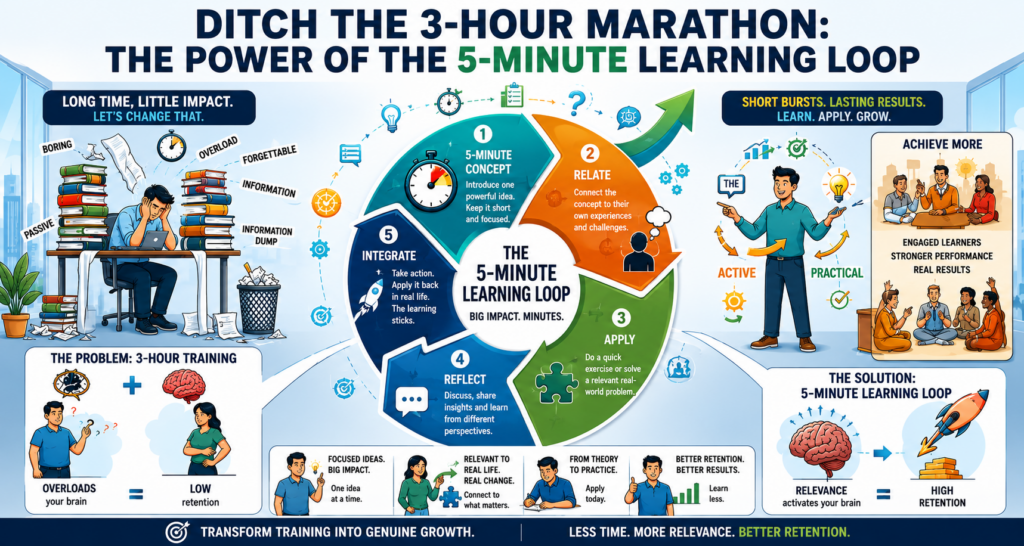
Think back to the last time you sat through a gruelling three-hour training session or flipped through a dense corporate manual. How much of that information did you actually retain by the time you walked out the door? If you are like most people, the answer is frustratingly little.
In the modern workplace, we have become obsessed with content volume. We overload employees and students with hours of uninterrupted lectures, expecting them to memorise facts. But true, transformative learning doesn’t happen when we passively record data. It happens when we interact, relate, and experience. To fix this, we need to look at how humanity successfully passed down knowledge before the invention of the modern classroom.
The Wisdom of Ancient Learning
Long before rigid syllabi, modules, and heavy textbooks existed, education was fundamentally interactive. Ancient philosophers and teachers didn’t use slide decks; they sat with their disciples and engaged in open dialogue. Knowledge emerged naturally from immediate questions, real-world situations, or sudden insights shared out of pure necessity. The student’s real-world challenge was the curriculum.
Enter the 5-Minute “Loop Approach”
Subjecting people to hours of continuous instruction completely paralyses cognitive retention. A far more effective method is what we call the “loop approach”.
Under this framework, direct lecturing is strictly capped at five minutes. You introduce a single, potent concept—and then you stop talking. Immediately after that short window, you present a practical exercise or a rhetorical question that forces the learner to look at that concept through the lens of their own life story.
Why Relatability Dictates Retention
Human brains are remarkably efficient sorting machines. If information does not feel directly relevant to our immediate reality, we discard it almost instantly.
Think about it: if you are actively trying to lose weight, your eyes will instantly lock onto a fitness article in the morning paper. A person who is already in peak physical shape will flip right past it. Your brain prioritises what is relevant to your current challenges. If you cannot relate to or physically experience a concept, it will never truly stick.
Shifting to Immediate Application
How do we bridge the gap between abstract theory and permanent knowledge? The answer is immediate, contextual practice.
Until you take a theory and physically apply it to your existing circumstances, it remains temporary data floating in your short-term memory. True retention comes from interactive and experiential learning—interacting with others and physically experiencing the concept, rather than just memorising dry academic terms.
When you step into your next professional development course, stop acting like a passive sponge. Challenge the process by bringing your real-life situations into the room. Ask your facilitator: “I am dealing with this exact problem at work right now—how do I use this framework to solve it?” By shrinking the lectures and anchoring theory in personal practice, we turn bloated training sessions into genuine engines of personal growth.