
What parents can do at home to secure their children’s future?
Our current education system was designed with a singular, narrow purpose: to prepare individuals for the job market. It offers no support in the development of a “whole” human being—failing to help one become a better child, a better spouse, or a more conscious servant of God. Furthermore, it has never even claimed to consider, let alone plan for, success in the afterlife.
The Collapse of the Economic Promise
As we enter 2026, the global landscape has undergone a radical transformation. A decade ago, this system at least functioned as a reliable pipeline for employment. Today, it is failing even at that. Does any rational thinker still argue that this traditional model can deliver economic success?
Let us be clear: the sole objective of this system was to make individuals “earnable.” It was an incomplete attempt at financial preparation. Given the reality of the world in 2025 and the current predictions for the future, we can no longer claim that this system secures one’s financial destiny.
A System Without a Soul
Beyond economics, does this system protect the future of the family? Does it decrease divorce rates, foster marital harmony, or assist in the proper upbringing of children? Does it safeguard mental health? For the last 150 years, the modern world has stripped these objectives from the educational agenda. Its only “solution” was the promise of a corporate job. But as we look at the corporate landscape of 2026, we must ask: will those jobs even exist, and is this system providing the tools to navigate a post-corporate world?
The answer is a resounding “No.” The system was based on feeding information to the learner, rather than facilitating a transformation into a curious, critical, and creative individual capable of leading a happy life.
The AI Intervention
In the last three years, Artificial Intelligence has further exposed these systemic flaws. In our schools, many teachers struggle to provide information that students can now access in seconds at home. The same disruption is happening in the job market. There is no longer a guarantee that the technologies learned in a university will still be relevant by the time a graduate enters the workforce.
The Solution: Home as a “Learning Club”
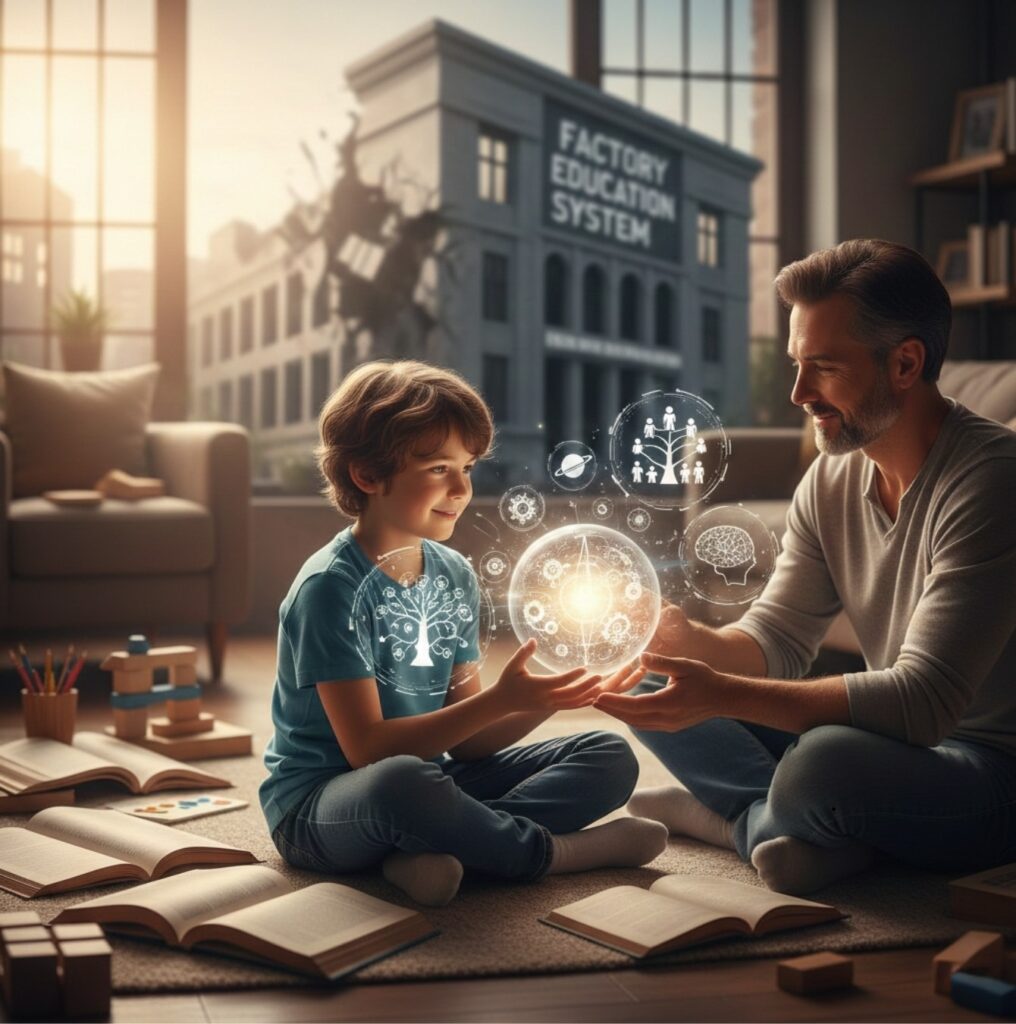
While the education system takes its time to evolve, I urge you: do not sacrifice your child’s confidence, creativity, or self-worth at the altar of this failing model. Your home should not be a secondary school; it should be a Primary Learning Club. Your focus must shift from information to transformation through “Natural Learning.”
Early Childhood:
Nourishing Curiosity. Focus on physical nourishment and developing a curious mind. When a child asks, “Why is the sky blue?”, do not reach for Google. Instead, ask: “That’s a great question—why do you think it isn’t green or red?” Encourage them to hypothesise before they memorise.
The Middle Years:
Critical Analysis. As they grow, encourage them to analyse the systems around them. Ask: “If you were the Principal for one day, what rule would you change and why?” This helps them realise the world is a series of systems they can influence and improve.
Adolescence:
Discovering Purpose. From age 13 onwards, encourage children to explore their natural talents. Whether it is a trade skill, a sport, or a specific academic passion, let them find a lifelong love for learning. When a child finds their “element,” earning opportunities follow naturally.
A Call to Action
These skill sets—curiosity, critical thinking, and self-discovery—will give your child the “real confidence” to survive in the competitive world of 2026 and beyond. Do not destroy your relationship with your children over the pressure of exams and grades. If the system cannot even guarantee their financial survival, do not let it rob them of their humanity as well.